The Modular Phone Is Back in 2026 And This Time It Might Actually Work | Zexton
MWC 2026 just revealed the thinnest modular phone ever 4.9mm, magnetic modules, and up to 10,000mAh battery. Here's everything buyers need to know. (148 chars)
Hold a 4.9mm smartphone base unit in your hand it barely feels like a phone. No battery bulk. No camera bump. Just a wafer of glass and aluminium that fits inside an envelope. That is the starting point for TECNO's modular phone 2026 concept, unveiled on the floor of MWC Barcelona 2026 this week and it is the most serious challenge to the way we buy smartphones that we have seen in a decade.
At Zexton, we have watched the modular smartphone space fail twice before. We saw Google's Project Ara collapse. We watched Motorola's Moto Mods quietly disappear. So when a new modular smartphone 2026 concept appears on a trade show floor, our instinct is scepticism. But what TECNO showed at MWC this year deserves a harder look because several things that made modular phones impossible in 2016 have genuinely changed in the last twelve months.
This article covers everything a buyer needs to know: exactly how TECNO's magnetic module system works, why previous attempts failed and what is different this time, how modular compares to foldable phones in 2026, and what the Zexton team honestly recommends right now.
What Is a Modular Phone? (And Why Does It Matter in 2026)
A modular phone is a smartphone whose hardware components camera, battery, lens, speaker, and other peripherals can be physically attached, swapped, or upgraded without replacing the entire device. Instead of buying a new phone every two years to get a better camera, you purchase only the camera module. Instead of carrying a portable charger, you snap on a battery pack. The core device stays the same; only the capabilities change.
Think of it the way you might think of USB accessories on a laptop except instead of dangling cables, the add-ons integrate directly into the phone's body. TECNO's 2026 implementation achieves this through a precision magnetic array on the rear of the device. Eight distinct zones on the back panel act as contact and alignment points. Physical power transfer happens via pogo-pin connectors, while data moves wirelessly over Bluetooth, Wi-Fi, or mmWave automatically switching to the fastest protocol available for each module type.
Why does it matter specifically in 2026? Three converging trends make the concept more relevant now than it was at any point in the past decade. AI workloads are creating genuinely different hardware demands depending on use case a content creator and a field engineer should not need identical silicon. The EU's right-to-repair legislation, which came into force in 2024, has shifted consumer expectations toward repairability and longevity. And component miniaturisation has finally reached the point where a modular base device can be thinner than a standard flagship something that was physically impossible in 2016.
What TECNO Just Unveiled at MWC 2026 Full Module Breakdown
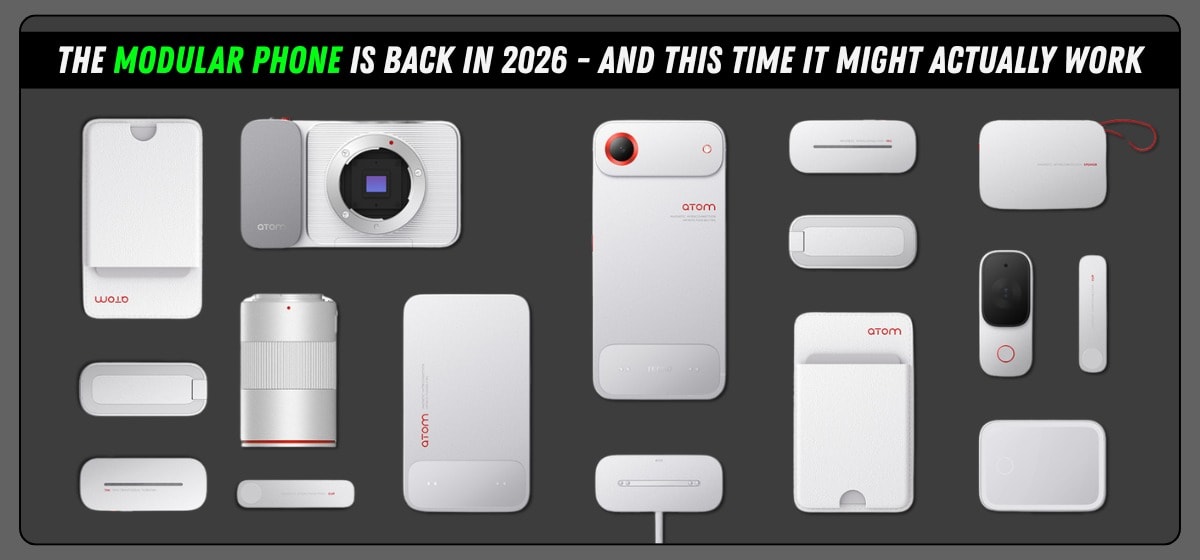
TECNO's Modular Magnetic Interconnection Technology concept arrived at MWC 2026 in two design families the clean, minimal ATOM Edition in silver-aluminium with red accent lines, and the bolder MODA Edition aimed at creative and lifestyle users. Both share the same modular architecture. Here is a section-by-section breakdown of everything on the stand.
The Base Device
The core unit measures 4.9mm at its thinnest point comparable to a hotel room key card. It houses the primary display, a basic rear camera module, the main processing chipset, and four pogo-pin connector pairs arranged in two zones on the back panel. Notably absent: a USB-C charging port. TECNO has removed wired charging entirely, replacing it with a dedicated charging module that attaches magnetically a bold decision that divides opinion but keeps the base device architecture as clean as possible.
Camera Modules
The headline module is a chunky telephoto barrel capable of extending optical zoom from the base 3.5x all the way to 20x, with a manual focus ring on the barrel for photographers who want tactile control. The module communicates via mmWave wireless, streaming a live preview through to the phone's main display. During hands-on testing at MWC, reviewers noted occasional latency in the live view something TECNO will need to resolve before commercial release.
For less intensive shooting, there is a streamlined periscope telephoto that adds reach without the bulk of the barrel lens. An ultrawide module completes the optical trio, covering virtually every focal length a content creator would need across a single device.
Action Camera and Communication Modules
One of the more unusual entries in the lineup is an action camera module that pairs to the phone via Wi-Fi and is capable of operating entirely independently detached from the handset as a standalone camera. A separate walkie-talkie antenna module is aimed at users in environments without cell service or Wi-Fi, using a foldout antenna to enable peer-to-peer communication without any network infrastructure. This positions the modular system squarely at field workers, outdoor enthusiasts, and emergency services users a buyer segment that premium flagship phones have historically ignored entirely.
Power Modules
Each 3,000mAh battery module is 4.5mm thin barely thicker than a credit card. The system allows stacking: two modules bring total capacity to 6,000mAh, three to 9,000–10,000mAh, exceeding the battery capacity of most mainstream smartphones on the market today. Combined with the base device's own cell (capacity unconfirmed at time of writing), the total potential power reserve is substantial. A separate charging module snaps over either pair of pogo connectors and handles all wired power delivery, since the base device carries no USB-C port.
Lifestyle and Utility Modules
The lineup extends to lanyard attachment connectors, camera grip clips, and a game controller module the latter not shown at MWC but confirmed as under development. TECNO also demonstrated speaker and microphone modules, rounding out a system designed to cover professional, creative, outdoor, and entertainment use cases from a single base device.
Table 1: TECNO Modular Magnetic Interconnection Full module comparison, MWC 2026
Why Have Modular Phones Failed Before? (And What Is Genuinely Different Now)
The honest answer to anyone who reacts to a new modular phone concept with "we have heard this before" is: you are right to be sceptical. The modular phone history is a graveyard of promising ideas that collapsed under the weight of their own complexity. Let us be direct about each one
Google Project Ara (2013–2016)
Project Ara was Google's attempt to build a fully modular smartphone from scratch every component, including the display, processor, and radio, would exist in a swappable block. The concept was genuinely revolutionary and captured enormous attention. It was cancelled in 2016 before a single consumer unit shipped. The reasons were manufacturing complexity, supply chain fragility, and the fundamental difficulty of maintaining radio frequency certification across infinite hardware configurations. The ecosystem problem was insurmountable: no manufacturer would build modules for a platform that had no installed base, and no installed base could form without modules.
Motorola Moto Mods (2016–2020)
Moto Mods took a more pragmatic approach: a standard Moto Z smartphone with magnetic module rails on the back. The execution was better than Project Ara: the Hasselblad camera module with 10x optical zoom was a genuinely impressive accessory, and the system worked reliably in daily use. But Moto Mods will be discontinued by 2020. The failure was not technical, it was commercial. Consumer adoption was too low to justify continued module development, and without a growing catalogue of modules, the ecosystem felt limited. The magnetic connection was also cumbersome compared to simply adding a better camera lens optically to a fixed device.
LG G5 (2016)
LG's attempt with the G5's 'Friends' modular system was the most short-lived of the three. The physical mechanism — requiring the user to slide out the bottom of the phone to swap the battery section — was awkward in practice, and the module quality did not justify the trade-off in device robustness. LG quietly dropped the system with the G6 in 2017.
So What Is Actually Different in 2026?
1. Hardware thinness is now viable.
The 4.9mm base device TECNO showed at MWC was physically impossible to build in 2016 at smartphone prices. Component miniaturisation particularly in display drivers, antenna design, and passive components has reached the point where a modular base can be thinner than most fixed flagships. This eliminates the biggest aesthetic barrier to adoption that sank Moto Mods.
2. Wireless data removes the connector complexity.
Google Project Ara failed partly because routing high-bandwidth data through physical connectors across arbitrary hardware configurations was an engineering nightmare. TECNO's system offloads complex data transfer to mmWave wireless, meaning the physical connectors only need to handle power, a far simpler engineering problem. The telephoto lens can stream a full live preview to the main display without a single data cable between them.
3. AI use-case differentiation creates genuine demand.
In 2016, a smartphone was a smartphone. The difference between a high-end and a mid-range device was primarily performance. In 2026, different users have genuinely divergent hardware requirements: a developer stress-testing local AI models needs different silicon than a wildlife photographer in a national park or a construction site manager coordinating off-grid. A modular platform that lets each user configure the device to their exact requirement addresses a real problem that fixed hardware cannot.
Modular Phone vs Foldable Phone 2026 Which Direction Is Smarter?
The two most discussed smartphone form factors heading into the second half of 2026 are foldables and modular devices. They represent opposite philosophies: foldables expand a single unified piece of hardware; modular phones extend a minimal core with add-on components. For a buyer deciding where to put their money right now, the comparison is worth making carefully.
Table 2: Modular phone vs foldable phone 2026 feature comparison for buyers
The honest Zexton verdict: if you are buying a smartphone today, a foldable is the safer choice. It is a proven product with a mature ecosystem and predictable performance. The modular concept has a more compelling long-term value proposition particularly for buyers who replace their phone primarily to get a better camera but it is not yet a product you can put in your pocket.
For buyers who want to invest in future-proof hardware thinking, the modular direction is the smarter bet if and when it ships. For buyers who need a device in March 2026, foldables represent the premium form factor tier.
The Green Angle How Modular Phones Could Fix the E-Waste Problem
The average smartphone is replaced every 2.3 years globally. The majority of discarded handsets still have fully functional screens, processors, and chassis they are replaced because a better camera or faster chip became available, not because the core device failed. This is one of the most wasteful consumption patterns in consumer electronics, contributing to an estimated 50 million tonnes of e-waste generated annually worldwide.
Modular design addresses this directly. If you can replace only the camera module when the next generation of optics arrives, the base device with its screen, chipset, and structural components remains in use for five to seven years instead of two. The environmental calculus improves at every link in the chain: fewer full device manufacturing cycles, less mining of rare earth materials, and a lower per-year carbon footprint for each user.
This is not merely a consumer talking point in 2026. The EU Right to Repair Directive, which came into force in 2024, mandates that consumer electronics manufacturers provide access to spare parts, repair documentation, and software support for a minimum product lifespan. Modular architecture is the logical hardware complement to right-to-repair policy and regulators in the UK and major Asian markets are watching the EU framework closely.
At Zexton, we believe the most sustainable tech investment is one that lasts. We actively support right-to-repair initiatives and offer a device trade-in programme designed to extend the useful life of electronics that still have value.
The Zexton Take What Should Buyers Do Right Now?
We have covered the technology, the history, and the comparison. Here is the direct answer: TECNO's modular concept is the most credible iteration of the modular phone idea since Motorola's Moto Mods and it is considerably more technically sophisticated. The magnetic module system, the 4.9mm base profile, and the breadth of modules in development are not trade show theatre. This is a serious piece of engineering, and it deserves to be taken seriously.
But it is not a product you can buy in 2026. There is no confirmed release date. There is no pricing. TECNO has explicitly described this as a concept and a long-term design thinking project. Anyone telling you to wait for a modular phone instead of buying a current flagship is asking you to wait for something that may not ship this year or at all.
Who Should Be Excited Right Now
•Content creators and photographers: The modular telephoto and ultrawide system, if it reaches commercial quality, would make a single device capable of replacing a multi-lens camera kit. Watch this space closely.
•Power users and tech enthusiasts: The architectural concept particularly the mmWave wireless module data transfer is a genuine advance. If you follow the space, MWC 2026 is a meaningful inflection point.
•Field workers and professionals: The walkie-talkie module and stackable battery system are purpose-built for use cases that flagship phones currently ignore entirely. These are genuinely differentiated features.
Who Should Buy a Flagship Now and Not Wait
•Everyday smartphone users: If you need a phone today, buy today. The best current flagship phones at Zexton will serve you better for the next two years than waiting for a concept to ship.
•Business buyers needing reliability: Unproven magnetic hold, a concept-stage ecosystem, and no confirmed release date are not acceptable variables for a primary business device.
Frequently Asked Questions Modular Phones 2026
What is a modular phone?
A modular phone is a smartphone where hardware components such as cameras, batteries, and lenses can be physically attached, swapped, or upgraded independently of the core device. Rather than replacing the entire handset to access new hardware, users purchase only the specific module they need. TECNO's 2026 concept uses a magnetic attachment array and pogo-pin connectors to enable this.
Can you buy a modular phone in 2026?
Not yet. TECNO's modular phone concept, shown at MWC Barcelona in March 2026, is still at the concept stage. The company has not confirmed a commercial release date, pricing, or availability in any market. Previous modular phones including Motorola's Moto Mods and Google's Project Ara either failed to reach consumers or were discontinued. Until TECNO announces a commercial launch, the best current smartphones remain available at Zexton.
How does TECNO's magnetic module system work?
TECNO's system uses an eight-zone magnetic array on the rear of the 4.9mm base device to align and hold modules in place. Physical power transfer happens through pogo-pin connectors. Data moves wirelessly using Bluetooth, Wi-Fi, or mmWave the system switches automatically to the fastest available protocol depending on the module attached. This allows the telephoto camera module to stream a live preview to the phone's main display without a physical data connection.
Are modular phones better than regular smartphones?
For customisation and long-term value, modular phones have a clear advantage users can upgrade individual components rather than replacing the whole device. For everyday reliability, current fixed-hardware smartphones are better proven. Modular phones introduce mechanical complexity (magnetic hold durability, module ecosystem dependency) that unified devices avoid. The right answer depends on use case: power users and content creators gain more from modularity than everyday users who prioritise simplicity.
What happened to Google Project Ara and Motorola Moto Mods?
Google cancelled Project Ara in 2016 before it reached consumers. The primary reasons were manufacturing complexity, radio frequency certification challenges across variable hardware configurations, and an unsolvable ecosystem bootstrapping problem. Motorola's Moto Mods launched commercially in 2016 with the Moto Z and included accessories like a Hasselblad camera module, but was discontinued by 2020 due to limited consumer adoption and an insufficient module ecosystem. LG's G5 modular system was dropped with the G6 in 2017 for similar reasons.