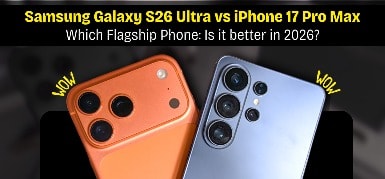
Samsung Galaxy S26 Ultra vs iPhone 17 Pro Max Which Is Better?
Compare the Samsung Galaxy S26 Ultra vs iPhone 17 Pro Max in camera, battery, display, performance, software, and value to find the right flagship for you.
If you are choosing between the Samsung Galaxy S26 Ultra and the Apple iPhone 17 Pro Max, you are already looking at two of the most premium phones on the market. Samsung positions the Galaxy S26 Ultra as its top Galaxy AI flagship with upgraded thermal management and faster charging, while Apple’s iPhone 17 Pro Max combines a 6.9-inch ProMotion display, premium build, and deep integration with the Apple ecosystem.
The right choice depends less on which brand is “better” and more on how you use your phone every day. The Galaxy S26 Ultra makes more sense for buyers who want stronger zoom flexibility, more customisation, and better multitasking tools. The iPhone 17 Pro Max is the better fit for buyers who want polished video, long-term iOS familiarity, and seamless pairing with devices like AirPods, Apple Watch, iPad, and Mac.
In this guide, we compare both phones in the areas that matter most before buying: design, display, performance, camera, battery, software, ecosystem, and value.
Samsung Galaxy S26 Ultra vs iPhone 17 Pro Max Quick Comparison
Samsung Galaxy S26 Ultra vs iPhone 17 Pro Max: Quick Verdict
Best for video recording and ecosystem:
The short answer is simple: buy the Galaxy S26 Ultra if you want more control, more zoom range, and a more versatile Android experience. Buy the iPhone 17 Pro Max if you want the smoothest Apple ecosystem experience, dependable video quality, and a flagship that feels familiar and refined.
Samsung Galaxy S26 Ultra vs iPhone 17 Pro Max: Key Differences at a Glance
Samsung and Apple take different approaches to a flagship phone. Samsung leans into versatility. The Galaxy S26 Ultra is designed around Galaxy AI, higher sustained performance, improved heat control, and faster charging, while also pushing zoom photography and multitasking as major strengths. Apple focuses more on polish, consistency, ecosystem continuity, and a highly refined user experience around iOS and Pro apps.
That means the Galaxy S26 Ultra is usually the better pick for users who want flexibility, long-range zoom, split-screen productivity, and a more open software experience. The iPhone 17 Pro Max is usually the safer pick for users who already own Apple devices, care a lot about video quality, and prefer a smoother, simpler experience over deeper customisation.
Samsung Galaxy S26 Ultra vs iPhone 17 Pro Max Specs Comparison
On paper, both phones clearly belong in the ultra-premium category. Apple’s iPhone 17 Pro Max has a 6.9-inch OLED ProMotion display with up to 120Hz refresh rate, 256GB to 2TB storage options, and a 233g weight. Samsung says the Galaxy S26 Ultra uses a customized Snapdragon 8 Elite Gen 5 for Galaxy chip, a redesigned vapor chamber for better cooling, and Super-Fast Charging 3.0 that can reach up to 75% in 30 minutes.
Raw specs matter, but they do not tell the full story. For most buyers, the real decision comes down to how these features translate into daily use: how comfortable the phone feels, how reliable the camera is, how long the battery lasts, and whether the software fits your habits.
Design and Build Quality
Which Phone Looks and Feels More Premium?
Both phones feel premium, but they give off different personalities. The iPhone 17 Pro Max feels more minimal and luxury-focused, with Apple’s clean hardware design and a familiar Pro Max shape. The Galaxy S26 Ultra feels more technical and utility-driven, like a phone built for people who want to do more with it. Apple lists the iPhone 17 Pro Max with an aluminum unibody design, Ceramic Shield 2 front, and Ceramic Shield back, while Samsung markets the S26 Ultra around power, thermal engineering, and AI performance.
If you want a flagship that looks sleek, familiar, and premium in a classic Apple way, the iPhone 17 Pro Max will appeal more. If you prefer a phone that feels like a powerful tool as much as a luxury device, the Galaxy S26 Ultra has the stronger identity.
Size, Weight, and In-Hand Comfort
These are both large flagship phones, so neither is built for people who want a compact device. Apple lists the iPhone 17 Pro Max at 233g with a 6.9-inch display, which tells you immediately that this is a big phone for big-screen buyers.
For daily comfort, this usually comes down to your habits. If you watch a lot of video, game often, read on your phone, or work on the go, a large display can feel worth it. If you care more about one-handed use, pocket comfort, or easy commuting, both phones may feel bulky compared with smaller models. In this matchup, the winner is less about size alone and more about which shape and grip feel better in your hand.
Durability and Everyday Usability
In this price range, buyers expect more than just premium materials. They want a phone that feels dependable every day. Apple’s Ceramic Shield and Samsung’s focus on sustained performance and thermal improvements both point toward long-term daily usability rather than just showroom appeal.
The practical question is this: which phone better matches your routine? If you are often outdoors, travel a lot, or push your phone hard with gaming and video, Samsung’s thermal improvements and fast charging are meaningful. If you want a device that feels predictable, polished, and easy to live with over time, Apple still has a strong edge in user familiarity and ecosystem convenience.
Display Comparison
Screen Quality and Brightness
Both phones deliver a flagship-level screen experience. Apple says the iPhone 17 Pro Max offers a 6.9-inch OLED display with ProMotion up to 120Hz and up to 3000 nits peak outdoor brightness. Samsung says the S26 series is designed for richer visuals and improved scaling through ProScaler, with the Ultra tuned for AI performance and visual enhancement.
In real life, that means both displays should look excellent for scrolling, streaming, reading, and gaming. Apple tends to feel especially polished in brightness control and colour consistency, while Samsung often appeals to users who prefer a more immersive, vibrant display style.
Which Display Is Better for Watching Videos and Gaming?
For entertainment, the difference is more about feel than quality. The iPhone 17 Pro Max has Dynamic Island, which some users are already used to and some still see as a distraction during fullscreen content. The Galaxy S26 Ultra will appeal more to buyers who want the most uninterrupted display experience possible for movies, YouTube, and gaming. Apple officially lists Dynamic Island on the iPhone 17 Pro Max, while Samsung emphasizes fluid gameplay and stronger GPU performance on the S26 Ultra.
If you care most about a cinematic, distraction-free feel, Samsung may have the edge. If you value overall polish and do not mind Dynamic Island, Apple remains a top-tier media phone.
Outdoor Visibility and Everyday Use
Apple’s published outdoor brightness figures are extremely strong, and Samsung’s focus on visual enhancement and premium display quality suggests that neither phone should struggle in normal daylight use.
For maps, messaging, browsing, and photography outdoors, both should perform at a high level. The better choice here depends on whether you prefer Apple’s more controlled display tuning or Samsung’s often more dramatic, high-impact presentation.
Performance and Speed
Everyday Performance
This is one area where most buyers should stop chasing benchmark differences. Both of these phones are flagship-fast. Samsung says the Galaxy S26 Ultra delivers up to 19% CPU, 24% GPU, and 39% NPU gains compared with the previous generation, with a redesigned vapor chamber for better sustained performance. Apple positions the iPhone 17 Pro Max as its top-end large-screen Pro model with ProMotion and storage configurations up to 2TB, clearly aimed at demanding users.
In normal daily use, both phones should feel instant for messaging, social apps, web browsing, camera use, and multitasking. Most users will not buy one of these phones and think it feels slow.
Gaming and Heavy Multitasking
This is where Samsung becomes more interesting. Samsung explicitly highlights thermal management, gaming fluidity, and all-day performance consistency on the Galaxy S26 Ultra. That matters for players who game for longer periods or buyers who use demanding apps, editing tools, or multiple tasks at once.
The iPhone 17 Pro Max remains a strong gaming and performance phone, but Samsung has the more obvious productivity and sustained-performance pitch. If you use split-screen, pop-up windows, or treat your phone like a mini workstation, the Galaxy S26 Ultra is likely the better fit.
Which Phone Feels Faster in Real Life?
The iPhone often feels smoother because Apple controls hardware and software tightly. Samsung often feels more capable because it lets you do more. Those are not the same thing.
So the “faster” phone depends on what you mean. If you mean polished and friction-free, many users will prefer the iPhone 17 Pro Max. If you mean flexible, power-user-friendly, and better for juggling many things at once, the Galaxy S26 Ultra is the stronger answer.
Camera Comparison
Main Camera Quality
Both phones should deliver excellent flagship-level photos in daylight. The biggest difference is usually image style. Samsung often aims for a more vivid, dramatic look, while Apple tends to favour a more natural and consistent rendering style. PhoneArena’s sample-photo comparison frames Samsung’s hardware upgrades and image processing as a major story in this matchup, which supports the idea that Samsung is pushing harder on photographic versatility here.
If you like photos that stand out immediately on a phone screen, Samsung may appeal more. If you prefer more neutral-looking shots and dependable point-and-shoot consistency, Apple still has a very strong case.
Ultra-Wide Camera
For landscapes, travel, architecture, and group shots, both phones should be excellent. What matters more than the sensor count is consistency: colour matching, edge quality, and how reliable the ultra-wide camera feels when lighting is not ideal.
In buyer terms, this section is not likely to decide the whole purchase unless you shoot a lot of scenery or travel content. Most users will care more about zoom and video than ultra-wide alone.
Zoom Photography
This is one of Samsung’s clearest advantages. PhoneArena specifically highlights Samsung’s dual telephoto setup against Apple’s single 4x setup, which reinforces Samsung’s flexibility for distant subjects and travel-style shooting.
If you photograph concerts, wildlife, buildings, city details, sports, or anything at a distance, the Galaxy S26 Ultra is the better choice. The iPhone 17 Pro Max will still be good for everyday telephoto use, but Samsung is the more compelling option for buyers who genuinely care about zoom range.
Portraits and Selfies
Both phones should perform well for portraits and selfies, but the difference usually comes down to colour preference and consistency. Apple often appeals to users who want quick, dependable front-camera results and natural-looking skin tones. Samsung can be more appealing to users who want a punchier look straight out of the phone.
For social sharing, either phone will work well. For buyers who want the safest, most consistent casual camera experience, the iPhone may be the easier recommendation. For buyers who enjoy more variety and flexibility across lenses, Samsung offers more room to play.
Low-Light and Night Photography
Night mode is where software matters as much as hardware. Samsung’s faster lens and new camera positioning suggest it is aiming to close gaps and improve low-light performance, while Apple remains known for dependable night shooting and stable processing. PhoneArena’s camera-focused comparison is especially useful here because it frames the contest around real sample photos rather than just spec sheets.
The practical answer: if you want a reliable point-and-shoot camera with strong consistency, Apple is still a safe bet. If you want more flexibility and are willing to lean into Samsung’s camera strengths, the S26 Ultra may be more exciting.
Video Recording
Video is where the iPhone 17 Pro Max remains especially attractive. Even when Samsung improves photography flexibility, Apple still tends to be the safer recommendation for users who shoot a lot of video, post content regularly, or want dependable stabilisation and colour consistency.
If you are a content creator, casual vlogger, or someone who often records family events, the iPhone 17 Pro Max is likely the better fit. If your priorities lean more toward still photography, zoom, and camera experimentation, the Galaxy S26 Ultra becomes more compelling.
Which Camera Is Better for Different Users?
Best for zoom and travel photography: Samsung Galaxy S26 Ultra
Best for video creators: iPhone 17 Pro Max
Best for point-and-shoot simplicity: iPhone 17 Pro Max
Best for camera flexibility: Samsung Galaxy S26 Ultra
Best for social video: iPhone 17 Pro Max
Best for long-range photography: Samsung Galaxy S26 Ultra
This is the fairest way to judge the camera battle. Samsung gives you more range and flexibility. Apple gives you more consistency and confidence, especially for video.
Battery Life and Charging
Which Phone Lasts Longer?
Battery life depends heavily on how you use your phone, but the broad pattern in flagship comparisons is usually this: Apple often feels slightly more consistent for endurance, while Samsung pushes harder on charging speed and power-user features. Samsung says the S26 Ultra is engineered for power efficiency and all-day use, while Apple’s Pro Max line has long been positioned as the biggest-battery iPhone experience.
For moderate users, both phones should comfortably last a full day. For heavy users, the difference may come down to whether you value a phone that squeezes out a bit more endurance or one that charges back up faster.
Charging Speed Comparison
This is a clearer Samsung win on paper. Samsung says the Galaxy S26 Ultra can reach up to 75% charge in 30 minutes with Super-Fast Charging 3.0. Apple’s iPhone 17 Pro Max tech specs page does not position charging in equally aggressive terms on the page we checked.
In real life, faster charging matters a lot if you travel, work long shifts, or frequently forget to top up overnight. If quick recharging is a priority, Samsung has the stronger value proposition.
Which Is Better for Heavy Users?
For heavy users, this is the trade-off:
Choose the iPhone 17 Pro Max if you care more about battery consistency and a dependable all-day flagship experience.
Choose the Galaxy S26 Ultra if you care more about high performance under load and the ability to recover quickly with faster charging.
Software Experience and Ecosystem
Android vs iOS: Which Experience Is Better?
This is the single biggest reason many buyers choose one phone over the other. Samsung’s One UI approach is better for people who want more customisation, more control, and stronger multitasking. Apple’s iOS approach is better for people who want simplicity, consistency, and a familiar experience that usually feels the same across their Apple devices.
Neither is universally better. The better one is the one that already fits your habits.
Galaxy AI vs Apple Intelligence
Samsung is clearly making AI a major pillar of the Galaxy S26 series. Samsung says the S26 lineup is engineered around always-on Galaxy AI features and stronger NPU performance to keep AI tasks seamless throughout the day.
For buyers, the important question is not which brand says “AI” more often. It is which features actually help in daily life. Samsung’s pitch is currently more explicit and more central to the phone’s identity. Apple’s strength remains the smoother integration of software, privacy expectations, and ecosystem continuity. Buyers who want AI-forward features may lean Samsung. Buyers who care more about stable long-term familiarity may still prefer Apple.
Which Phone Works Better With Your Other Devices?
If you already own a MacBook, Apple Watch, AirPods, or iPad, the iPhone 17 Pro Max has a huge built-in advantage. Apple’s ecosystem is one of the biggest reasons Pro Max buyers stay with iPhone.
If you use Windows, mix brands, or want more freedom in how your phone fits into your setup, Samsung is often the more flexible option. It is easier to recommend the Galaxy S26 Ultra to buyers who do not want to feel locked into one ecosystem.
Updates, Longevity, and Ease of Use
Apple remains one of the easiest brands to recommend for long-term user comfort. The iPhone experience is familiar, polished, and simple to keep using over the years. Samsung has improved dramatically in long-term support and is clearly investing heavily in performance, AI, and day-to-day usability on the S26 line.
For non-technical users, the iPhone 17 Pro Max is often the easier long-term choice. For users who enjoy features, flexibility, and getting more out of their phone, the Galaxy S26 Ultra may feel more rewarding.
Price, Storage Options, and Value for Money
Which Phone Gives You Better Value?
Value is not just about launch price. It is about whether you will actually use what you are paying for.
If you want zoom range, productivity, faster charging, and a more feature-rich experience, the Galaxy S26 Ultra may offer better value. Samsung’s flagship remains priced as its top-tier Ultra model, and third-party coverage reports it kept the same $1,300 starting price in the US as its predecessor. Apple’s iPhone 17 Pro Max starts at 256GB and goes up to 2TB, clearly targeting buyers willing to pay for premium storage and long-term ecosystem use.
If you already live in the Apple ecosystem and plan to stay there, the iPhone 17 Pro Max can still be the better value because it fits more smoothly into the rest of your devices and habits.
Best Storage Option for Most Buyers
Apple offers the iPhone 17 Pro Max in 256GB, 512GB, 1TB, and 2TB versions. For most buyers, 256GB or 512GB will be the sensible range depending on how much photo and video content they store locally.
Creators, frequent travellers, and heavy video users should consider higher storage. Casual buyers should avoid overpaying for storage they will never fill.
Is the Higher Price Worth It?
A flagship phone is only worth the money if its strengths match your real life. Paying more makes sense when you will actually use the better camera, the bigger display, the extra storage, the faster charging, or the deeper ecosystem features.
Do not buy the iPhone 17 Pro Max just because it is an iPhone. Do not buy the Galaxy S26 Ultra just because it has more camera flexibility. Buy the one that solves your daily needs better.
Who Should Buy the Samsung Galaxy S26 Ultra?
Buy the Samsung Galaxy S26 Ultra if:
you want stronger zoom and camera flexibility
you prefer Android and more customisation
you multitask often and use productivity features
you want a large, immersive display
fast charging matters to you
you want a flagship that feels more versatile day to day
you do not want to be tightly locked into Apple’s ecosystem
Who Should Buy the iPhone 17 Pro Max?
you already use Apple devices
you want strong video recording and dependable point-and-shoot results
you prefer iOS simplicity and long-term familiarity
ecosystem convenience matters a lot to you
you want a polished flagship experience that feels easy to live with
you care more about consistency than customisation
Samsung Galaxy S26 Ultra vs iPhone 17 Pro Max: Final Verdict
The Samsung Galaxy S26 Ultra and iPhone 17 Pro Max are both excellent flagship phones, but they are not excellent in the same way.
Choose the Samsung Galaxy S26 Ultra if you want more freedom, better zoom flexibility, stronger multitasking, faster charging, and a phone that feels more versatile across different use cases. Samsung’s official positioning around Galaxy AI, thermal upgrades, and charging speed supports that role clearly.
Choose the iPhone 17 Pro Max if you want the safest premium choice for video, ecosystem convenience, and long-term iPhone familiarity. Apple’s official specs reinforce that this is a polished, large-screen flagship aimed at buyers who want a premium experience without learning a new system.
Best for camera flexibility: Samsung Galaxy S26 Ultra
Best for video and ecosystem: iPhone 17 Pro Max
Best for productivity: Samsung Galaxy S26 Ultra
Best for long-term Apple users: iPhone 17 Pro Max
For most buyers, the final decision should come down to one question:
Do you want more freedom and flexibility, or do you want more ecosystem polish and familiarity?
Frequently Asked Questions
Is Samsung Galaxy S26 Ultra better than iPhone 17 Pro Max?
Not in every category. The Galaxy S26 Ultra looks stronger for zoom, flexibility, and productivity, while the iPhone 17 Pro Max remains stronger for ecosystem use, video-first buyers, and long-term iOS comfort.
Which phone has the better camera?
It depends on what you care about most. The Galaxy S26 Ultra is the better choice for zoom and camera versatility, while the iPhone 17 Pro Max is the safer choice for video and point-and-shoot consistency.
Which phone is better for gaming?
Both phones are powerful enough for serious gaming, but the Galaxy S26 Ultra has the clearer pitch around sustained performance, cooling, and fluid gameplay.
Which phone has better battery life?
Both should offer strong all-day battery life, but the answer depends on your usage style. The iPhone 17 Pro Max is often the safer pick for endurance, while the Galaxy S26 Ultra stands out more for quick recharge convenience.
Is the iPhone 17 Pro Max worth buying over the Galaxy S26 Ultra?
Yes, especially if you already use Apple products, shoot lots of video, and want the smoothest iOS experience. It is less compelling for buyers who care more about zoom photography, customisation, and Android productivity.
Which phone is better for business use?
The Galaxy S26 Ultra may suit productivity-focused users better because of its flexibility and multitasking strengths, while the iPhone 17 Pro Max may suit people working inside Apple-heavy environments better.
Which flagship offers better value in 2026?
That depends on what you will actually use. Samsung may offer better value for flexibility and hardware versatility, while Apple may offer better value for long-term ecosystem users.